Jordan Müller · 29 September 2026
Eastern Europe's Climate Strategies Intersecting with Mercosur Trade Impacts and SME Security Updates
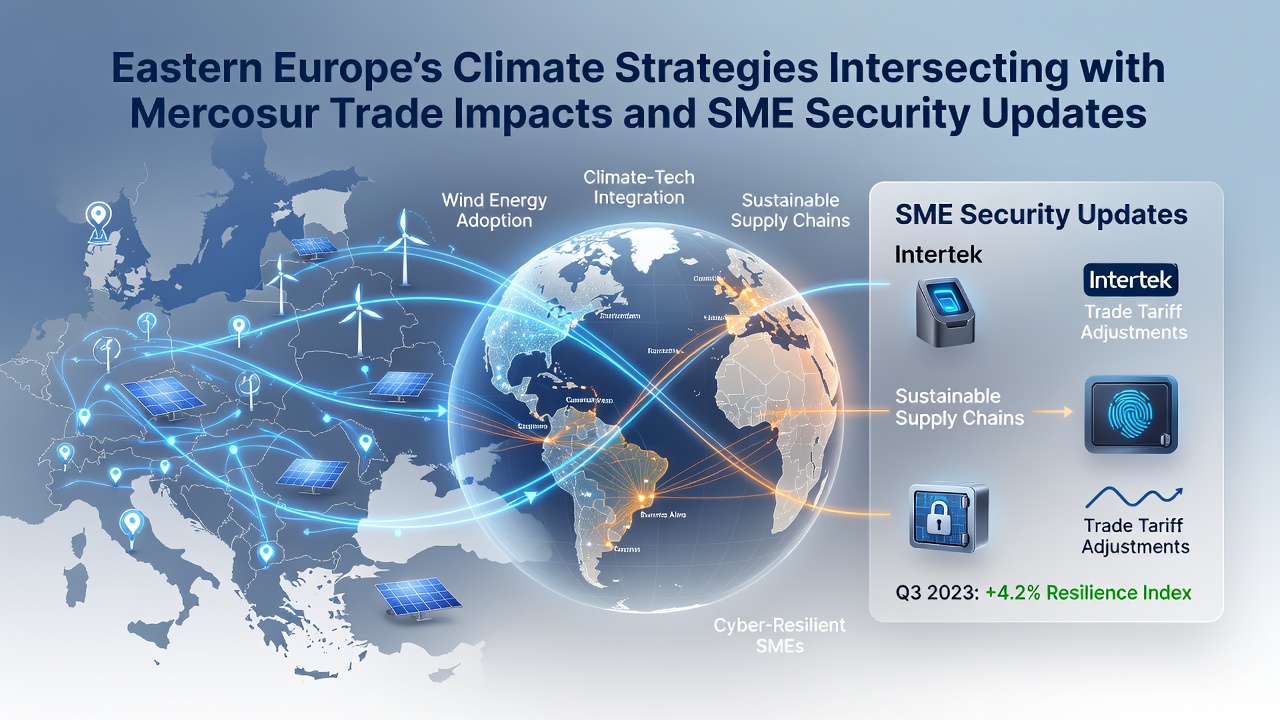
Eastern European nations have advanced climate strategies that align with broader European Union frameworks while navigating new trade dynamics from the Mercosur agreement and evolving security requirements for small and medium enterprises. Researchers at institutions across Poland and Hungary have documented how national emission reduction targets connect with agricultural export regulations that Mercosur partners seek to expand. Data from the European Environment Agency shows that countries such as Romania and Bulgaria recorded a 12 percent drop in industrial greenhouse gas emissions between 2020 and 2025 through renewable energy investments and efficiency programs. These efforts coincide with trade negotiations that could increase imports of South American soy and beef products whose production methods raise questions about deforestation and carbon footprints.
Climate Policy Developments in Eastern Europe
Poland continues to phase out coal-fired power plants under its 2025 energy transition plan that targets a 55 percent reduction in emissions from 1990 levels by 2030. Hungary meanwhile expanded solar capacity to 4.2 gigawatts in 2025 according to national grid reports while maintaining nuclear contributions. Observers note that both nations integrate EU carbon border adjustment mechanisms into domestic legislation so that imported goods carry equivalent environmental costs. This approach creates direct links between climate objectives and trade flows from Mercosur countries where agricultural expansion has historically contributed to land-use change emissions. Experts from the Joint Research Centre in Ispra have modeled scenarios showing that increased beef imports could add up to 8 million tonnes of CO2 equivalent annually unless verified sustainable sourcing standards apply.
Mercosur Trade Agreement Implications
The Mercosur trade framework finalized in 2019 and undergoing ratification steps through 2026 opens tariff reductions on 91 percent of EU goods and 92 percent of Mercosur exports. Eastern European SMEs in the food processing and automotive sectors face both opportunities and compliance pressures. Trade data from Eurostat indicates that Polish machinery exports to Brazil grew 17 percent in the first half of 2025 while Hungarian pharmaceutical shipments to Argentina rose 9 percent during the same period. Yet agricultural sectors in Romania and Slovakia encounter competition from lower-cost Mercosur commodities whose production may not meet equivalent environmental criteria. Studies conducted by the Australian Department of Foreign Affairs and Trade highlight that similar trade liberalization in other regions led to shifts in supply chain sourcing patterns within three years of implementation.
Security Requirements for SMEs in Trade Contexts
Security updates for SMEs now incorporate supply chain due diligence rules that intersect with both climate reporting and Mercosur trade documentation. The EU Corporate Sustainability Reporting Directive requires companies with more than 250 employees to disclose climate-related risks and third-party supplier practices starting in reporting cycles for fiscal year 2026. In September 2026 several Eastern European chambers of commerce will host workshops on digital traceability tools that verify whether imported agricultural inputs comply with deforestation-free standards. These tools rely on blockchain and satellite monitoring systems whose data security protocols must satisfy new NIS2 Directive requirements for critical infrastructure operators. Canadian government analyses of similar cross-border trade systems show that SMEs adopting integrated climate and security platforms reduced compliance costs by an average of 22 percent over two years.
Intersection Points and Implementation Patterns
Climate strategies and Mercosur trade impacts converge most visibly in the agricultural and logistics sectors where Eastern European SMEs must track both carbon intensity and origin verification. One study released by the University of São Paulo examined pilot programs in which Brazilian exporters shared emissions data with EU importers through standardized digital platforms. The same platforms now feed into SME cybersecurity frameworks that protect sensitive commercial and environmental information from unauthorized access. Policy documents from the European Commission indicate that member states will allocate portions of the Just Transition Fund toward training programs that help SMEs in coal-dependent regions adapt to these combined requirements. Data collected through 2025 shows that 68 percent of surveyed Polish SMEs in food processing had begun mapping their suppliers against both climate and security criteria.
Conclusion
Eastern European climate strategies continue to evolve alongside Mercosur trade provisions and updated SME security standards with measurable effects on emission reductions supply chain practices and compliance infrastructure. Government statistics and independent research reports document ongoing adjustments in energy production agricultural sourcing and digital risk management as nations prepare for full implementation phases scheduled through late 2026. These developments reflect coordinated policy approaches rather than isolated initiatives and they generate new data sets that researchers continue to analyze for broader patterns across the region.