
Parker Weber · 24 November 2026
Tracing Energy Funding Choices That Are Reshaping Cybersecurity Rules for Farming Cooperatives Across Central Europe
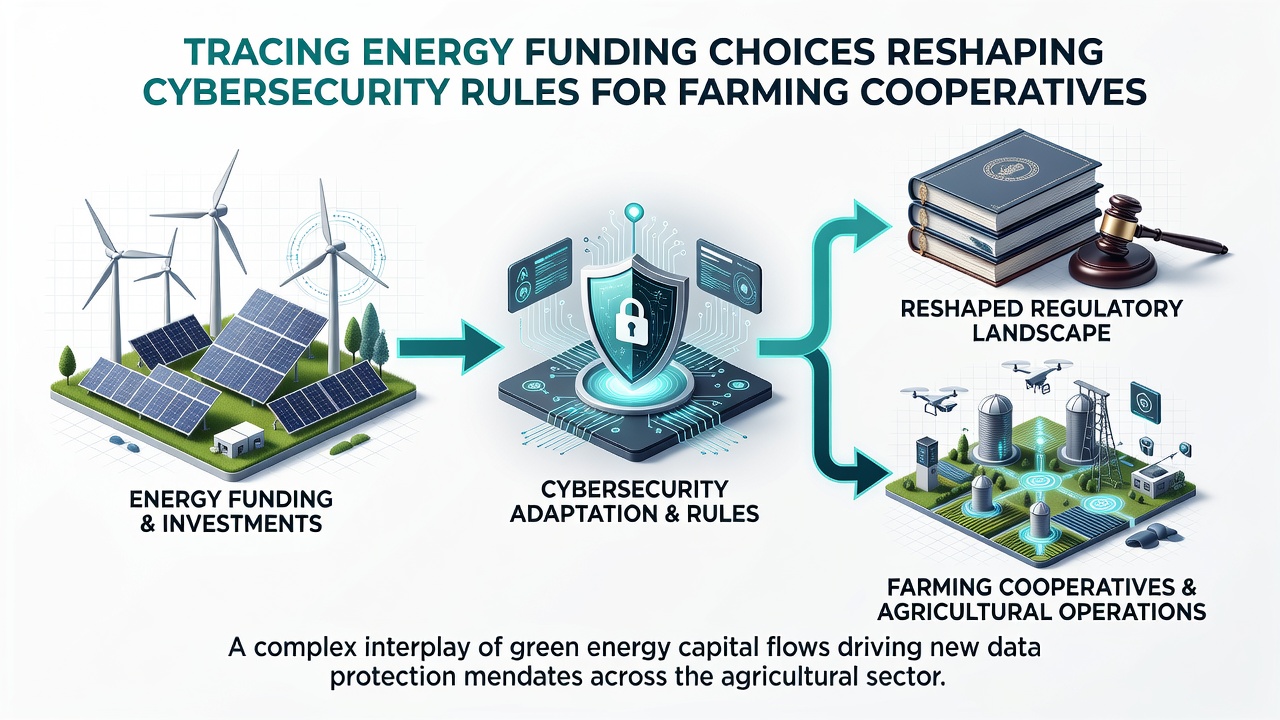
Energy funding programs from the European Union and national governments have directed substantial resources toward renewable installations and efficiency upgrades on agricultural land in Poland, Hungary, the Czech Republic and Slovakia since the early 2020s, and those allocations now tie directly into cybersecurity obligations for farming cooperatives that manage data from smart meters, irrigation controls and livestock tracking systems.
Funding Streams and Their Reach
Grants under the EU's Just Transition Fund and national recovery plans have supported solar arrays, biogas plants and grid connections for cooperatives in regions that previously relied on coal or imported gas, while disbursement rules increasingly require recipients to demonstrate compliance with network security standards before final payments are released. Data from the European Commission shows that Central European agricultural projects received over 2.8 billion euros in combined energy support between 2021 and 2025, and a growing share of those funds now carries explicit clauses on digital resilience.
Cooperative boards in eastern Poland and western Hungary have reported that applications for new funding rounds must include risk assessments for industrial control systems and supply-chain software, a requirement introduced after audits revealed vulnerabilities in older monitoring platforms. Those assessments draw on the NIS2 Directive framework, which member states began transposing into national law in 2024 and 2025, yet enforcement details for the agricultural sector continue to evolve.
Regulatory Adjustments Taking Shape
National cybersecurity agencies have started aligning subsidy conditions with sector-specific guidance issued by the European Union Agency for Cybersecurity, and observers note that farming cooperatives must now segment operational technology networks from administrative systems when they accept public energy grants. In Slovakia, updated ministerial decrees effective from November 2026 will mandate annual penetration testing for any cooperative that has drawn more than 500,000 euros in energy-related support over a three-year period.
Similar provisions appear in draft Czech legislation that links continued access to feed-in tariffs for biogas facilities to documented incident response plans. Researchers at the Czech Technical University in Prague have tracked how these overlapping requirements affect smaller cooperatives that lack dedicated IT staff, and their preliminary findings indicate that many groups now pool resources through regional associations to meet audit standards.
Practical Effects on Cooperative Operations
One cooperative near Debrecen in Hungary replaced its legacy SCADA system after an energy grant review flagged outdated firmware as a compliance gap, and the upgrade was completed using a combination of national subsidies and technical support from a state agricultural research institute. The change allowed the group to maintain eligibility for further renewable funding rounds while reducing exposure to remote access threats that have targeted rural infrastructure elsewhere in teh region.
In the Czech Republic, several dairy cooperatives have introduced multi-factor authentication and encrypted data flows between field sensors and central databases as a direct result of funding conditions tied to the national energy efficiency program. Figures released by the Czech Ministry of Agriculture show that 47 cooperatives completed such digital upgrades in 2025, representing a 34 percent increase from the previous year.
Cross-Border Patterns and Shared Challenges
Cross-border working groups formed under the Visegrad cooperation framework have begun exchanging templates for cybersecurity policies that satisfy both energy funding rules and data protection requirements under GDPR, and these exchanges have accelerated since mid-2025 when several Polish and Slovak cooperatives faced delayed grant payments over incomplete security documentation. The pattern suggests that cooperatives operating across regional borders may soon face harmonized reporting formats rather than separate national checklists.
Industry associations representing agricultural producers have noted that training programs on secure remote monitoring are now bundled with energy efficiency workshops funded by the same EU budget lines, and participation rates have risen steadily as cooperatives recognize the linkage between continued grant access and demonstrated digital safeguards.
Conclusion
Energy funding choices continue to serve as the primary mechanism through which cybersecurity expectations reach farming cooperatives in Central Europe, and the November 2026 deadlines in Slovakia and parallel measures elsewhere indicate that this linkage will remain a defining feature of agricultural policy in the region for the foreseeable future. Cooperatives that integrate security planning into their energy project proposals have maintained smoother access to grants, while those still adapting face tighter scrutiny from both funding bodies and national regulators.